Wednesday, February 23, 2011

Thoreau's Claim

Claim:


Through nature, Thoreau attempts to bring meaning of life through the simplicity found within his environment around Walden Pond.


Techniques to make claim: Repetition/Word Choice--

Repetition is prevalent throughout Thoreau’s writing. Repetition of words allows for a concentration on central themes throughout the readings. It also allows for Thoreau to state his ideas and claims to his audience and allows them to reflect on what he was saying through his tone.

Examples:

p. 19 (life)--- The meaning of life to him and allows readers to connect with his experience.
p.20 (simplicity)--- Through the use of simplicity, Thoreau makes it known that man should live as nature does through only using what we need.


Sunday, February 6, 2011

Grizzly Man Questions

1. Herzog's purpose in revealing Treadwell's death so early in the film seemed to try to explain that this isn't a story about his death, but more of answering questions and informing the audience on Treadwell's experiences in the wild with the grizzly bears. Revealing Treadwell's death allowed for Herzog to point out the reality in what Treadwell was doing. The reality was more than Treadwell thought it was. Later on, Herzog shows an interview with Treadwell's parents, revealing a pretty normal upbringing and making the audience wonder what has caused such behaviors from Treadwell. Treadwell develops hatred towards human interactions, resulting in his desires of protecting the grizzly bears although many people may believe different.

2. By using the term "I believe," Herzog and his film become less credible. Herzog continuously brought in his opinion into the documentary. Especially during a documentary intended to relay information to the public, personal opinions are not appropriate. When a narrator shares personal opinions it comes out as judgement and is hard for the audience not to believe them. As for entering his own film, I believe Herzog does so in order to help relay emotion to the audience. Throughout the film, friends and family of Treadwell are shown, so obviously talking about his death would be emotional, but when Herzog enters it is someone from the outside and allows for the audience to connect more. By appearing in the documentary, Herzog presents the audio of Treadwell's death and allows for the audience to imagine what they are hearing. This significantly increases the emotional aspect for the audience as it reels them into the documentary.

3. In Grizzily Man, Herzog seemed to show clips that portrayed Treadwell in a bias manner as he continuously showed sleeps that Treadwell wouldn't have want shown to the general public. A lot of times, the actor side of Treadwell was shown, which made him less credible in his videos as he continuously shot scenes over with different emotions. This is not necessarily bad on Herzog's part as it does show the real side of Treadwell was and helps understand him as a character. His childish actions portrayed throughout the documentary may have harmed Treadwell's imagine as it was hard to take him seriously at times. As for his family, were more concerned with the positive work he had done to 'protect' the bears. He had a passion for these creatures and wanted to be surrounded by them in his life. The portrayed him as a very moral character who was very accomplished in what he did. Herzog and Treadwell's family seemed to have conflicting views at times.

4. Tim Treadwell began his adventures in order to strive to protect the grizzly bears from any dangers they may have been facing through humans. Tim did say he was thee to protect them, but there was not any evidence in the documentary that he did anything to do so. There did not seem to be any immediate threats to the grizzly bears. Therefore, even though Treadwell would disagree, I don't believe that his goal of protecting the bears was a noble one. Instead, it was only habituating them to human presence. Through interviews with bear experts, it was suggested that Treadwell may actually be doing more harm than good. One had mentioned that the grizzly bear population is pretty stable and the human presence may help keep the population under control. Also, another had mentioned that its even a sign of disrespect and one shouldn't invade on their territory and that Tim had crossed the boundary. As the documentary went on and I saw what clips were being shown, I began to believe that Herzog's purpose in making this documentary might have been to discredit Treadwell for his actions.

5. There was clear evidence throughout the documentary that Treadwell wasn't happy about human life as it was. Through a look at his childhood it had seemed that he wanted to mutate into a wild animal, or more specifically a bear. Tim mentions that the grizzly world is simple, yet harsh, but wanted to be a part of nature. He even went as far as saying 'Death is the best option.' Herzog defends the biologist's statements by showing clips of Tim's childhood and how he never had good relationships with humans. He wanted to cross the invisible line between humans and bears and become part of their world. Treadwell's credibility was still tested when he stated at one point that he was all alone on the island with grizzlies, when in fact, he was not. Although Tim wanted to develop a relationship with bears, he still maintained that human connection with the outside world.

6. Death seems to be a common denominator in this documentary. There is death present throughout nature including death of the bears or the foxes and even the death of Treadwell. I believe Herzog included the statement, "I believe the common denominator of the universe is not harmony, but chaos, hostility, and murder," because it shows Treadwell as a sensitive character who is sentimentalizing the beauty of nature around him. He seems to believe that everything is harmonic and pure in nature, but this is just not the case. All this death in the environment is natural as he helps control the populations of these creatures, but Timothy does not seem to understand that there is death all around the animal world. Through this statement, I feel like Herzog seemed to be intentionally bashing Treadwell's intentions like he has seemed to do throughout the documentary.

7. The audio tapes in the documentary of Treadwell's death were not directly released to the viewing audience. This may have been done out of a sign of respect as it would have been inappropriate unjust to play the tapes during the documentary. Also, by the way Herzog presented it, it allowed for the audience to keep wondering and to imagine their own sounds on the audio tape and what they would be hearing if they were listening to it. Herzog presents the tape as he is with Jewel, Tim's former girlfriend. The audience is focused on Jewel's reactions to Herzog's. I believe Herzog may have wanted this because she probably responded more dramatic than if he were to be shown. Herzog asks Jewel to destroy the tape because it is gruesome, but there is a sense in the way it was filmed that this was possibly not the first time Herzog hears this tape. I don't think it was necessarily unethical because he did not choose to share the tape with the audience, but a lot of it did seem staged including the scene with the forensic scientist.

8. An interview with Herzog's parents is placed near the end of the film to give the audience a sense of his earlier life to see if there were any connections to his behavior as he grew up. Timothy seemed to have a normal everyday life with pretty normal upbringing and even receiving a scholarship to Bradley University for diving. Unfortunately, this is where his life changed. He began to struggle with drugs and alcohol in college and had a near fatal overdose. Timothy just seemed different than everyone. He want a new start and changed his name and headed to California to pursue acting. I believe Herzog waited to show this because he wanted to show the audience why Timothy became such a character and showed his motives in being a grizzly man. Herzog may have waited so long because he wanted to be able to show his own view of Tim's character before the audience sees the real cause of his character.

Monday, January 31, 2011

From Walden; or, Life in the Woods by Henry David Thoreau

     Nature is an integral part of Thoreau's life in From Walden; or, Life in the Woods by Henry David Thoreau. Through nature, Thoreau attempts to bring meaning of life through the simplicity found through his environment around Walden Pond. Thoreau shows a deep connection to his environment living at Walden Pond. This was Thoreau's way of making the most out of his life and said, "I wished to live deliberately, to front only the essential facts of life." Nature was life to Thoreau. Nature was the reality to Thoreau's life.
     The theme of simplicity life and nature are immersed in the way he is living around Walden Pond. Henry was proud of the fact that he built his own house through tools that were essentially free. He realized the ideas of making several things more simple whether its walking instead of taking the train or building things yourself. Thoreau would be outraged by society today. He would see the advancement and complication life now has. The theme of simplicity surrounding Thoreau's writing seems to have disappeared in todays society.

Wednesday, January 26, 2011

Imitation: 7 P.M., Thursday, August 25, 2005; Blood Dazzler p. 5

Original:

I see

                    what this language does

and taste

                    soil on my tongue

and feel

                    brick splintering spine

and hear

                    them

and want it

                   all


Imitation:

I see

                  the art of sand as inhabitants hurdle through the castle gates

and taste

                  the tingle of refreshment as ice touches the tongue

and feel

                  the blistering rays as they penetrate the skin

and hear

                 the crash of the shoreline as sand and bodies are swept into the lake

and I want it

                 forever


Description: I decided to take a different approach to place as I decided to describe a positive rather than the negatives Patricia Smith uses by using similar language found in her poems.

Blood Dazzler Poems by Patricia Smith

     Whenever a natural disaster occurs, horrific images of destruction and suffering may flash through peoples' heads. They invoke deep thought and emotion. In Patricia Smith's Blood Dazzler, poems illustrate emotion, destruction, scenes, and stories all through her writing on the experiences people faced after Hurricane Katrina. Smith gives readers the opportunity to attempt to feel like they were part of the destruction and devastation prevalent throughout and after Hurricane Katrina. Through poems like What Was the First Sound on page 19, Smith provides details the sights, sounds, colors, and feel after Hurricane Katrina hit. Using such details provides readers with an eerie feeling of being there and experiencing what Patricia Smith is seeing or experiencing herself. She does a wonderful job in putting readers in her shoes at it is tough to do when destruction can be extremely visual. The fact that Smith provides character in the Hurricane, often using first person to personify it, allows for Hurricane Katrina to seem more real and relatable to people around the country that haven't experienced the disaster first hand. Although people may not get quiet the credibility from Patricia because she is from New York, not New Orleans, she still does an excellent job conveying and bringing out emotion through the scenes and stories her writing portrays. I did not have a problem with her being an outsider as she did seem to have a connection and even sympathized for New Orleans, which allowed her to gain a connection with the disaster and her readers as well.

Monday, January 24, 2011

The Summer Day by Mary Oliver

Imagining oneself on a warm, lazy summer day, one may fail to notice the nature around them as the sun blares down onto their skin. Through details of a summer day, Mary Oliver challenges the reader to think about the smaller things in nature as she focuses in on a grasshopper. Oliver seems to be saying that being able to take notice, pay attention and appreciate the smallest of creatures is very similar to saying a prayer as she says, "I don't know exactly what a prayer is" as she described the grasshopper. Oliver seems to be asking her readers to spend a lifetime or even a day being able to appreciate and understand nature. She offers a profound, yet delicate example of life and illustrates it as a precious gift. The use of the grasshopper is random, yet emphasizes beauty and contribution to life. Also, I had noticed that there were no rhymes in the poem, possibly symbolizing the unpredictable pattern of life as we see it. Through the lines, "Who made the world?" and "Tell me, what else should I have done," Oliver seems to be symbolizing the journey through life from birth to death. Through the use of the grasshopper and details of life, Mary allows the reader to see that life is being taken for granted and that one must stop and look at nature around them and appreciate what God has given us.

Wednesday, January 19, 2011

Is This Kansas by Eula Biss

     Stereotypes are prevalent in all aspects of life. One stereotype that affects students my age is the typical college party stereotype consisting of alcohol, sex, and drugs. Through Eula Biss' essay "Is This Kansas," she examines the college experience through her view as a professor at the University of Iowa. Biss looks at the truth surrounding college campuses and opens by describing a scene of, "The car crashes, the falls from balconies, the alcohol poisonings. The football game days, on which cars crept toward the stadium in long, slow lines and everyone wore black and gold. The empty plastic cups under bushes, the idle boys on decaying porches, the midnight Ping-Pong tournaments, the windows illuminated by neon beer signs" (131-132). Biss uses short, quick language to paint a scene of a 'typical' college night and the nature of college students.

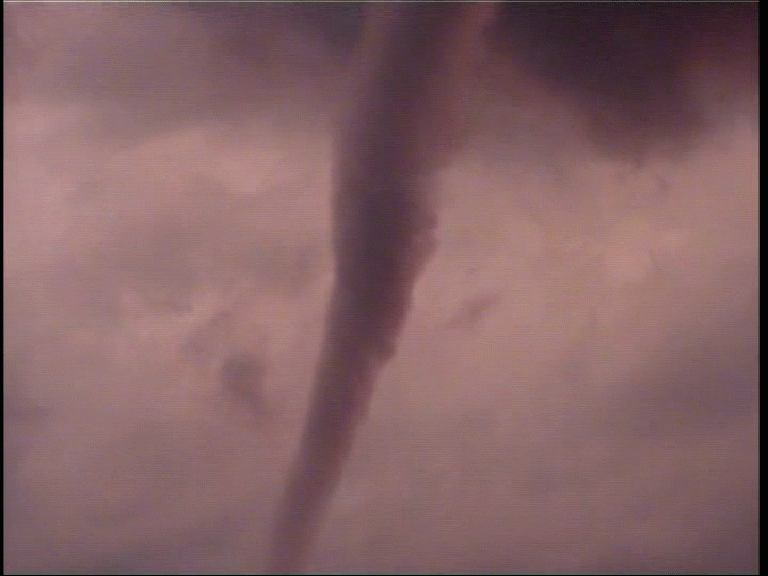
     Through Biss' experience at the University of Iowa and interactions with students, Biss sees how non-observent and ignorant the students may be. In Biss' last year at the University of Iowa, a major tornado struck Iowa City, resulting in severe damage to the college town. Biss' details the students' reactions of the storm by describing the scene as entertainment to students as, "Some students dragged a couch into the street and sat on it, while some others gathered around cases of beer in a parking lot." These are the details that stick out as they make the reader feel emotion towards the students' actions as well as picture the ironic image of the students sitting back on a couch watching the destruction that lay in their streets. The students are even hypocritical as they pointed out the wrongdoings associated with the citizens of New Orleans after Hurricane Katrina like looting, robberies, and other such incidents, while they were doing it themselves after the tornado. The disrespect on behalf of the students to the environment and surrounds really illustrates what lies ahead in our future. Being able to read and connect with the environment present at University of Iowa, I kind of wonder to myself if that would be the case here or at any other college campus? Through the details given by Biss, it is really easy to be able to picture this happening anywhere, but in reality I hope that its only an isolated experience.